
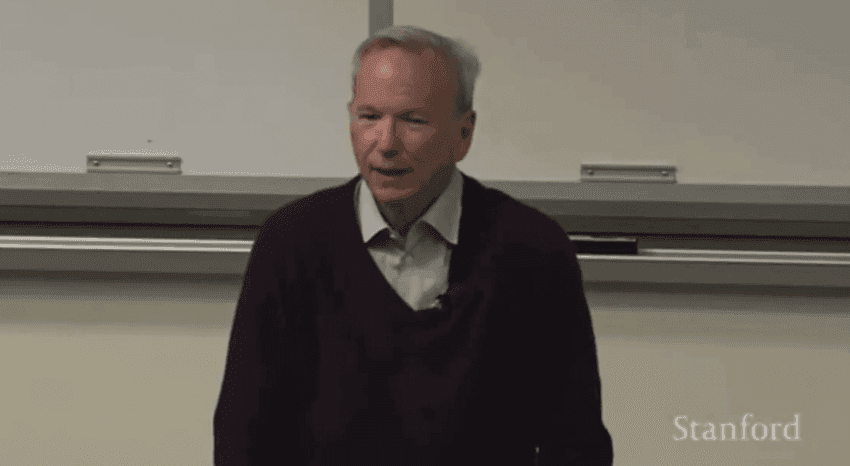
I wrote this after watching Eric Schmidt discuss AI around September 2024. The mood around AI can change in a few months, so parts of it may already feel dated. I still want to keep what caught my attention at that moment.
The Rapid Progress of AI
Schmidt said AI is changing so quickly that we may need a new interview every six months. It can sound exaggerated, but the period since ChatGPT makes the point feel reasonable.
What stayed with me was the discussion of million-token context windows, AI agents, and Text to Action. Text to Action still seems especially interesting: if a spoken instruction can lead all the way to an actual task, the way we use computers could change significantly.
Why AI Infrastructure Matters
Schmidt emphasizes that AI needs enormous investment, especially hardware infrastructure such as NVIDIA GPUs.
“NVIDIA became a two-trillion-dollar company because most code has to run on CUDA optimized for NVIDIA GPUs.”
That made me realize that AI is not only about building a good model. GPUs, electricity, data centers, and CUDA have to move together underneath it.
AI's Social Impact
Schmidt thinks AI could have a larger social impact than social media. That idea stayed with me. Social media changed relationships and how we consume information; AI could change how we study, work, and make decisions.
International Competition
AI is not only a competition between companies. It is also a competition between countries, especially the United States and China. That competition may accelerate progress, but it could also widen the gap between countries that can use AI and those that cannot.
My View
Schmidt's argument leans toward AI's possibilities. I like AI and use it often, but there are too many unresolved questions for simple optimism: whether its decisions are fair, how bias is handled, how jobs change, and how personal data should be processed.
As Schmidt also suggested, AI may become a game dominated by wealthy countries. I keep wondering how that gap could be reduced.
Closing Thoughts
The interview reminded me that AI cannot be reduced to “good” or “dangerous.” It is one of the most interesting technologies I can learn by using and building, but it also raises questions society has to answer together.
I want to keep testing AI instead of praising it from a distance, and record which parts are genuinely useful and which parts are risky.